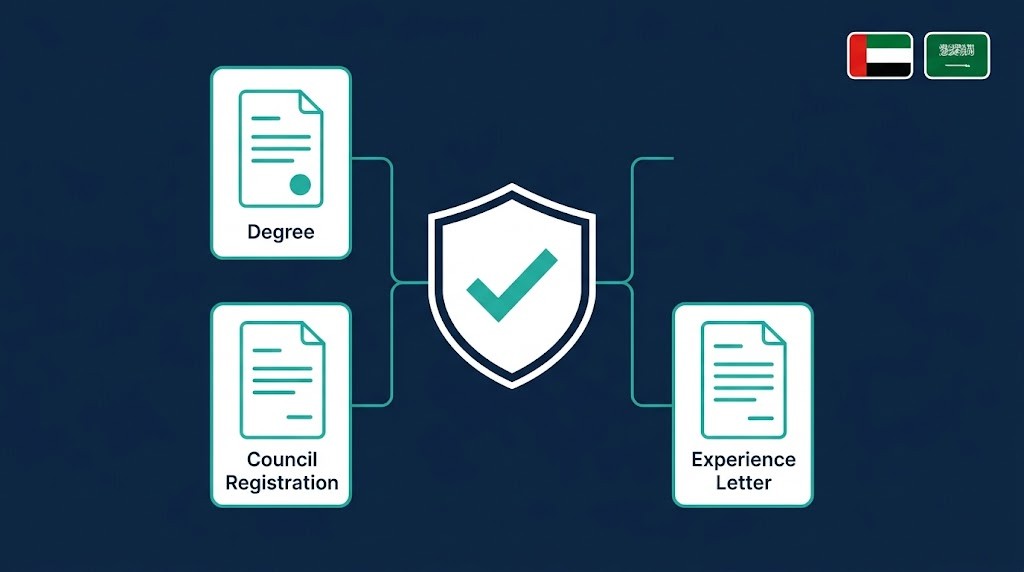
DataFlow verification is a mandatory primary source check of your medical degree, professional registration, and work experience — required by every GCC health authority before they process your licence application. A private company (DataFlow Group) contacts your university, home-country council, and employers directly. It takes 25–60 working days. Each GCC authority needs its own separate case. Start it as early as possible — ideally the same week you confirm your target country.
You’ve just received a job offer at a hospital in Dubai. HR sends over a checklist. Right at the top: “Complete your DataFlow verification.” You search for it. Half the articles call it “a verification service.” The other half assumes you already know which authority you’re applying to and jumps straight into document lists. Neither one tells you what DataFlow actually does to your documents overnight, who calls your university on your behalf, or how long you’ll genuinely be waiting.
That’s what this guide covers.
What is DataFlow verification, exactly? Why does every GCC country insist on it? What comes out at the end? And — the question nobody else answers clearly — should you start it before or after you sit your licensing exam?
If you’ve just started exploring a GCC healthcare career and you’re hearing “DataFlow” for the first time, you’re in the right place.
What Is DataFlow Verification?
DataFlow verification is a primary source check of your medical degree, professional registration, and work experience — done by contacting your university, council, and employers directly.
It’s called “primary source verification” (PSV) because DataFlow Group goes to the original issuing institutions — not to you — to confirm your credentials are genuine. They contact your university to confirm you graduated, your home-country licensing council to confirm your registration is valid, and your previous employers to confirm your experience dates match what you’ve declared.
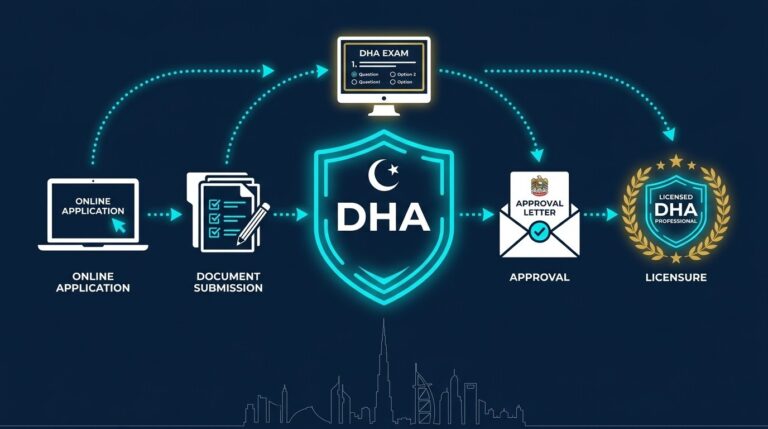
The result is a DataFlow PSV Report. That report is sent directly to whichever GCC health authority you’ve applied to — the Dubai Health Authority via the Sheryan portal, the Department of Health Abu Dhabi, SCFHS in Saudi Arabia, and so on. Without a positive DataFlow report, your licence application doesn’t move. Not one step.
Think of it this way: submitting a GCC licence application without a completed DataFlow report is like showing up to immigration at the border without a visa. The documents might be real. The authority still won’t proceed.
If you want help managing your DataFlow submission from start to finish, our DataFlow verification service covers document preparation, pre-submission audit, and weekly follow-up with institutions until your report clears.
Is DataFlow a Government Body or a Private Company?
DataFlow Group is a private company, not a government authority. GCC health regulators contract them to verify credentials independently before issuing any healthcare licence.
This surprises a lot of applicants. DataFlow Group is a private verification company contracted by GCC health authorities to handle PSV on their behalf. It’s not a UAE government department. It’s not part of DHA, DOH, SCFHS, or QCHP. It’s an independent third party that the authorities trust to contact institutions and confirm your credentials without bias.
Their main portal is dataflowgroup.com, and since 2024 the login and case management has migrated to dfgateway.com — the current DataFlow gateway for all new applications in 2026.
Why does this matter? Because applicants sometimes wait for a “government response” that’s actually sitting with a private company. And because when DataFlow contacts your university or council, that institution is responding to a private verification request, which occasionally means slower turnaround times than you’d expect from an official government process.
The authority you’re applying to still makes the final licensing decision. DataFlow just tells them whether your documents check out.
Which GCC Authorities Require DataFlow Verification?
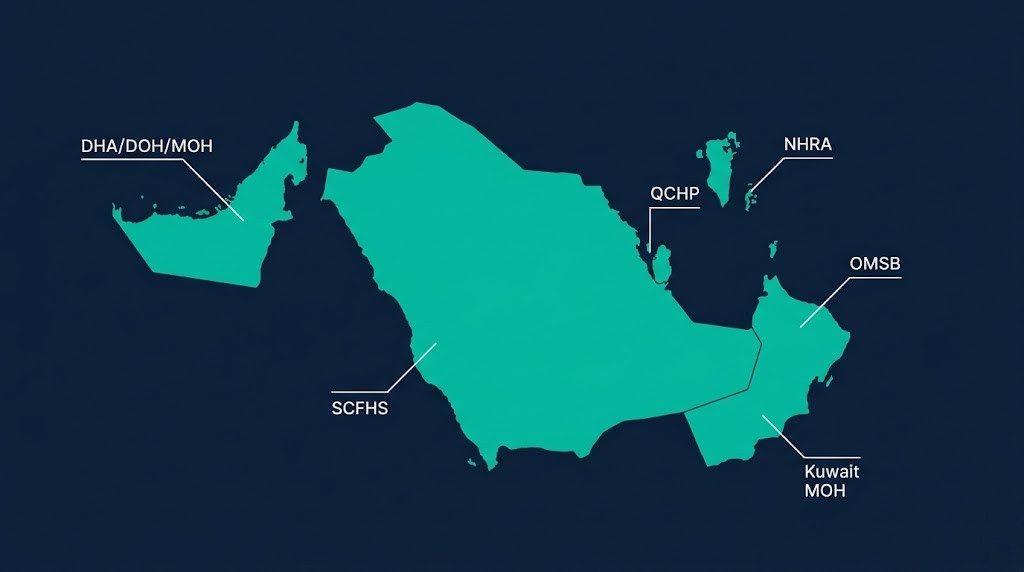
All six GCC countries require DataFlow — DHA, DOH, and MOH in the UAE, SCFHS in Saudi Arabia, QCHP in Qatar, NHRA in Bahrain, OMSB in Oman, and Kuwait MOH.
Here’s how each maps to its portal and system:
UAE — three separate authorities, all require DataFlow:
- DHA licence Dubai — Sheryan portal — Dubai emirate only
- DOH licence Abu Dhabi — Malafi system — Abu Dhabi only
- MOH licence Northern Emirates — MOHAP portal — covers Sharjah, RAK, Ajman, Fujairah, UAQ
These three share a country but have zero cross-recognition. A positive DataFlow report submitted to the DHA via Sheryan is not automatically valid for a DOH application via Malafi. Each needs its own case.
For a full breakdown of the three UAE authorities and which one applies to your job location, the DHA vs DOH vs MOH comparison covers the differences in detail.
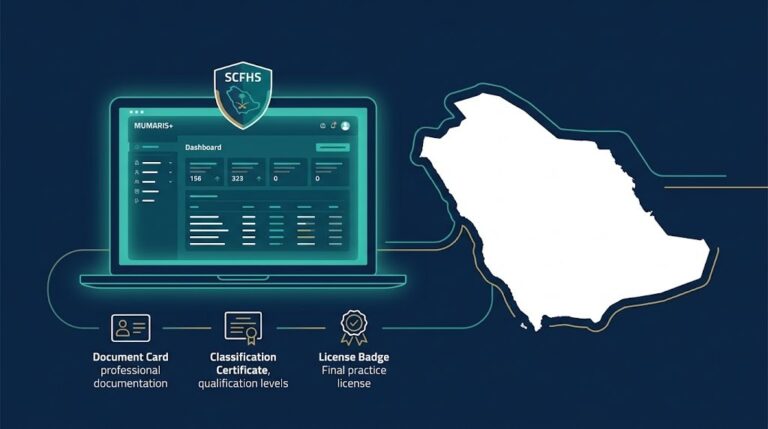
Saudi Arabia — SCFHS: The Saudi Commission for Health Specialties uses Mumaris+ as its licensing portal. SCFHS requires a positive DataFlow report before they’ll unlock your exam eligibility. You can’t sit the Saudi Prometric MCQ until DataFlow clears — which is a critical planning point we’ll come back to.
Qatar — QCHP: The Qatar Council for Healthcare Practitioners requires DataFlow PSV for all foreign-trained professionals. Case type options include New Case, Retrospective, and Report Transfer under specific conditions.
Bahrain — NHRA: The National Health Regulatory Authority requires DataFlow verification. Bahrain is generally the fastest GCC licensing process at 3–4 months total.
Oman — OMSB: The Oman Medical Specialty Board requires DataFlow PSV for foreign-trained applicants.
Kuwait — Kuwait MOH: The Kuwait Ministry of Health requires DataFlow as part of the foreign professional registration process.
What Documents Do You Submit for DataFlow?
You submit your passport copy, medical degree and transcripts, home-country council registration, good standing certificate, experience letters, CV, and a passport photo.
That’s the standard set. Most DHA, DOH, and SCFHS applications cover 3–5 documents in a single package. Here’s what each document covers:
- Passport copy — identity verification
- Medical degree and academic transcripts — DataFlow contacts your university directly
- Home-country council registration certificate — they contact your licensing council (NMC India, Philippine Regulatory Commission, PMDC Pakistan, NMC UK, AHPRA Australia, etc.)
- Good standing certificate — confirms your registration has no suspensions or restrictions; must be recent (usually within 3–6 months)
- Experience letters — from each employer covering dates, job title, and duties; DataFlow contacts employers to confirm
- CV — dates must match your experience letters exactly; mismatches trigger discrepancies
- Passport-size photo
One thing most guides don’t mention: document format matters. Blue-ink signatures on certain certificates, stamped letters on official letterhead, and exact date matches between your CV and employer letters are all scrutinised. A date discrepancy of even a few weeks can return a “Discrepancy” outcome and delay your licence by months.
How Long Does DataFlow Take in 2026?
DataFlow officially takes 25–35 working days. If your university or home council is slow to respond, real-world timelines stretch to 45–60 working days or longer.
The DataFlow Group FAQ quotes the standard processing period as up to 25–35 working days from the point all documents are accepted. You can track each document’s status on the portal — it shows “verification in progress” per item until the institution responds.
In practice, the biggest delays come from three sources:
1. Home-country councils — Some councils (including certain state-level medical councils in India) take 3–6 weeks to respond to verification requests. This is outside DataFlow’s control and outside yours.
2. Employer verification — If a previous employer has closed, restructured, or has a slow HR department, experience verification can stall for weeks.
3. Name inconsistencies — If your degree certificate shows a maiden name and your council registration shows a married name, DataFlow flags the discrepancy and pauses verification until you clarify it.
Fees in 2026 run approximately AED 300–500 per document verified. Most DHA-type packages (3–5 documents) land around AED 1,235 flat, though institutions sometimes charge additional fees on top of that when they respond to verification requests.
What Are the Possible Outcomes of a DataFlow Report?
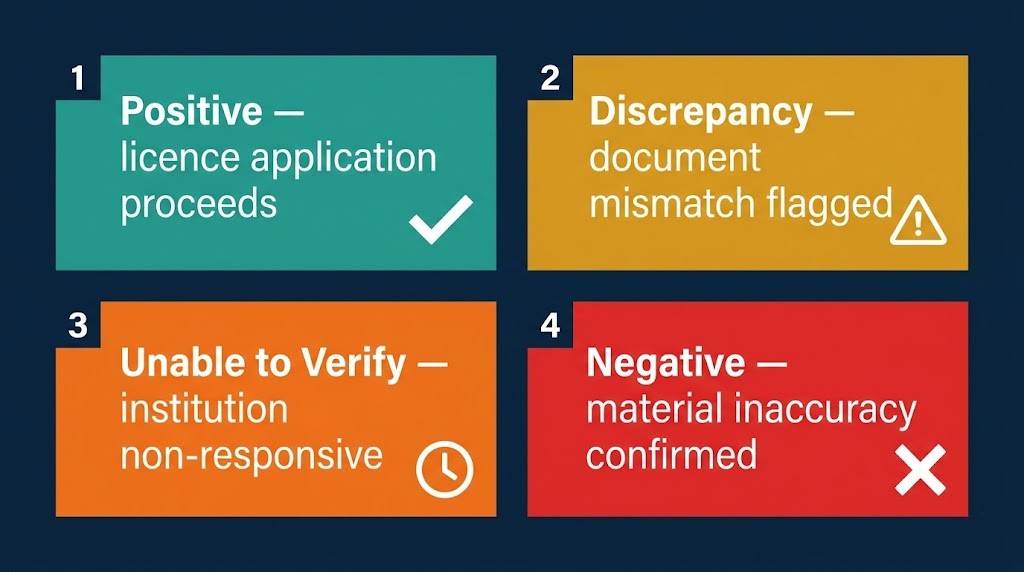
A DataFlow report returns one of four outcomes: Positive, Discrepancy, Unable to Verify, or Negative. Only a Positive report unlocks your GCC licence application.
Here’s what each means in practice:
Positive — All documents verified successfully. The report is sent to your target authority, and your application moves forward.
Discrepancy — DataFlow found a mismatch between what you declared and what the institution confirmed. Common causes: date differences between CV and experience letters, name variations across documents, or a degree transcript that doesn’t match the university’s records exactly. You’ll need to resolve the discrepancy and may need to resubmit documents.
Unable to Verify — The institution didn’t respond within the verification window. This doesn’t mean your credentials are fraudulent — it means the university, council, or employer failed to reply. DataFlow will attempt re-contact, but timelines extend significantly.
Negative — The institution confirmed a material inaccuracy. This is the most serious outcome and may affect your licence application permanently with that authority.
If your report returns anything other than Positive, you have 180 days to file an appeal via dataflowstatus.com. You’ll need your case number and passport. Appeals require you to supply documentation that explains or resolves the discrepancy — not just a resubmission of the same materials.
Here’s a real situation we’ve handled: an Indian pharmacist from Kerala with 3 years of hospital experience applying for a DHA licence had her report flagged “Unable to Verify.” DataFlow had contacted her Pharmacy Council of India registration, but the name on her council card (married name) didn’t match the name on her pharmacy degree (maiden name).
We identified the mismatch before it escalated to a Negative outcome, coordinated the correction documentation with the Pharmacy Council of India, and resubmitted. Her DataFlow cleared in 38 working days total, and her DHA licence followed shortly after.
Should You Start DataFlow Before or After Your Licensing Exam?
Start DataFlow immediately — don’t wait for your exam result. Verification takes 25–60 working days, and running both in parallel saves 6–10 weeks off your total timeline.
This is the question no competitor article answers clearly, and it’s the one that costs applicants the most time when they get it wrong.
The assumption many healthcare professionals make: “I’ll pass my exam first, then sort out the documents.” The problem is that for SCFHS in Saudi Arabia, exam eligibility is locked until your DataFlow report clears. You can’t sit the Saudi Prometric MCQ without it. So waiting for exam results before starting DataFlow doesn’t just cost you time — in Saudi Arabia, it literally blocks exam entry.
For UAE authorities (DHA, DOH, MOH), the exam and DataFlow run in parallel. You can sit your Prometric MCQ while your DataFlow is still processing. Start both at the same time.
The risk of starting DataFlow before you’ve confirmed your target authority is small. If you apply to DHA and later realise you want DOH instead, your DataFlow report needs to be resubmitted under the DOH case — but the documents you’ve already gathered are the same. The preparation work isn’t wasted.
Our standard recommendation: confirm your target authority, then start DataFlow and exam preparation in the same week. That parallel track approach is one of the reasons our clients typically license 6–10 weeks faster than those who apply sequentially. For a full picture of UAE licensing options, start with the authority overview before deciding.
Can You Reuse a DataFlow Report for Another GCC Country?
Each GCC authority requires its own DataFlow case. A DHA report cannot be reused for SCFHS, QCHP, or NHRA — you must open a separate application for each authority.
This is one of the most common misconceptions we see from applicants who’ve already been licensed in one GCC country and are now moving to another. “I already have a DataFlow report from my DHA application — can I just transfer it to SCFHS?”
The short answer: usually no.
Each DataFlow case is opened under a specific authority. The PSV report is generated for and sent to that authority. A DHA DataFlow case is a DHA document. SCFHS needs its own.
There is one partial exception: DOH Abu Dhabi offers a “Report Transfer” option that allows an existing DataFlow report to be transferred under specific conditions — typically if the same documents are being verified for a different application type within DOH. This is not a cross-country transfer. It’s an intra-DOH mechanism.
If you’re planning to work across multiple GCC countries over your career, build that into your budget and timeline from the start. Each new authority means a new DataFlow case, new fees, and a new 25–60 working day window.
DataFlow by Profession and Nationality: What Changes?
The documents are the same across professions. What changes is which home-country council DataFlow contacts — and how fast that council responds.
This is the section every generic DataFlow guide skips. Here’s why it matters:
Indian nurses — DataFlow contacts the Indian Nursing Council (INC) or the relevant state nursing council, depending on where you registered. INC can be slow to respond, and older nursing certificates sometimes lack clear duration stamps, which triggers “Unable to Verify” flags. Attestation chain before DataFlow submission: state nursing council registration, then Ministry of External Affairs (MEA) attestation, then UAE Embassy attestation.
Indian pharmacists — DataFlow contacts the Pharmacy Council of India (PCI) or the relevant state pharmacy council. A common issue: pharmacists with registration cards that lack a validity date or official stamp. Make sure your PCI registration is current and clearly stamped before submitting.
Filipino nurses — DataFlow contacts the Philippine Regulatory Commission (PRC). PRC is generally responsive, but the DFA (Department of Foreign Affairs) red-ribbon apostille on your PRC documents must be valid. Expired apostilles are a frequent cause of delays.
Pakistani doctors — DataFlow contacts the Pakistan Medical and Dental Council (PMDC). PMDC verification can take 4–6 weeks. Ensure your PMDC registration is active, not lapsed.
UK-qualified professionals — DataFlow contacts the Nursing and Midwifery Council (NMC UK) for nurses, the General Medical Council (GMC) for doctors, or the General Pharmaceutical Council (GPhC) for pharmacists. UK councils are typically fast responders. The main issue for UK applicants is experience letters — NHS trusts sometimes issue generic letters that don’t specify exact job duties, which DOH in particular requires.
For profession-specific UAE licensing requirements, the country page outlines what each authority expects by professional category. For Saudi Arabia, the Saudi SCFHS licensing guide covers profession-by-profession requirements in detail.
What to Do Next
If you’ve read this far, you know what DataFlow verification is, how long it takes, what outcomes are possible, and why starting early matters. The next step is confirming which GCC authority applies to your target job location — then getting your documents assessed before you submit anything.
That’s exactly what our free eligibility assessment covers. We check your documents, flag any inconsistencies before DataFlow sees them, and tell you honestly whether your profile is ready to submit. No cost. No obligation.
DataFlow Readiness Check
Find Out Exactly What You Need
3 quick questions. Get your DataFlow authority, timeline, and next step.
Step 1 of 3
Which country are you applying to?
Step 2 of 3
What is your profession?
Step 3 of 3
Where are you in the process?
Your DataFlow Summary
Frequently Asked Questions
Q: What is the difference between DataFlow verification and document attestation?
A: DataFlow verification (PSV) confirms your credentials are genuine by contacting the issuing institutions directly. Document attestation is a separate process that legalises your documents for use in a foreign country — typically involving your home country's Ministry of Foreign Affairs and the UAE Embassy. Both are usually required for GCC licensing, but they run as separate processes.
Q: Can I track the status of my DataFlow application?
A: Yes. Once your case is open, you can track each document's verification status on the DataFlow portal (dfgateway.com). Each document shows "verification in progress" until the relevant institution responds and confirms. You'll receive an email notification when your full report is ready.
Q: What happens if my previous employer has closed down and can't respond to DataFlow?
A: DataFlow will attempt to verify through alternative means — HR registries, labour court records, or official employment confirmation from a relevant government body. If verification is genuinely impossible, the outcome may be "Unable to Verify" for that document. You should gather any alternative proof of employment (payslips, employment contracts, tax records) before opening your case, and flag this to your consultant in advance.
Q: Do I need a new DataFlow if I'm renewing my GCC licence?
A: Not always. If you're renewing a licence with the same authority and your credentials haven't changed, some authorities accept the existing DataFlow report. If you've changed employers or your council registration has lapsed and been renewed, a fresh DataFlow case may be required. Check directly with your target authority before renewing.
Q: How much does DataFlow verification cost in 2026?
A: Fees are package-based. A standard DHA-type package covering 3–5 documents runs approximately AED 1,235 flat. Per-document rates sit around AED 300–500, though certain issuing institutions (some universities and councils) charge additional response fees that are shown on the DataFlow portal when you select that institution. Fees vary by authority and by the number of documents in your case.