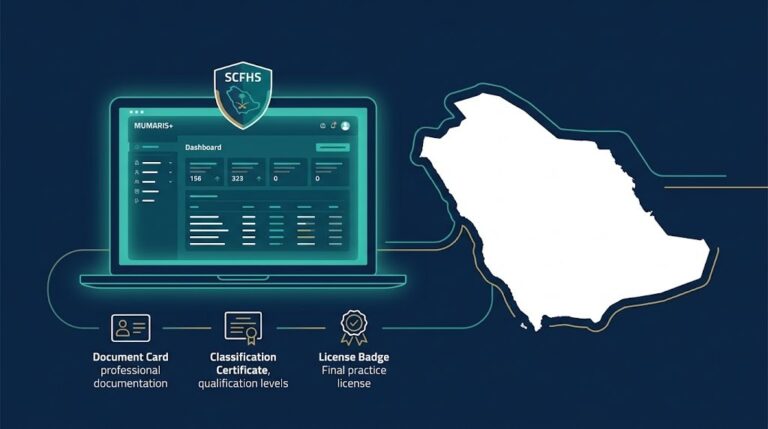

SCFHS, the Saudi Commission for Health Specialties, is the sole authority that licenses all healthcare professionals in Saudi Arabia. Without SCFHS registration, no doctor can legally work in any hospital or clinic in the Kingdom. The process runs through the Mumaris+ portal and covers DataFlow primary source verification, a Prometric exam for most doctors, and final professional registration. Total timeline: 5 to 8 months. Free eligibility assessment available via WhatsApp.
Every week, we hear from doctors who’ve accepted job offers in Riyadh or Jeddah, only to discover they need a licence they’ve never heard of before they can start. That licence is the SCFHS professional registration. It’s not optional. It’s not something your employer can bypass. And without it, no Saudi hospital, government, or private, can legally put you on the floor.
If you’re a doctor considering work in Saudi Arabia, understanding SCFHS is the first thing you need to get right. This article explains exactly what it is, why the Kingdom requires it, how doctors are classified, and what the licensing path looks like from start to finish.
What Is SCFHS?
SCFHS, the Saudi Commission for Health Specialties, is Saudi Arabia’s sole licensing authority for all healthcare professionals, established by Royal Decree M/2 in 1992.
The Saudi Commission for Health Specialties is a government body headquartered in the Diplomatic Quarter in Riyadh, with six regional branches across the Kingdom covering Jeddah, Al Khobar, Al Ahsa, Abha, Al Madinah, and Buraidah. It was created specifically to set the standards for healthcare practice in Saudi Arabia, supervise training programmes, administer licensing examinations, and issue professional credentials.
Think of it as the single regulatory gate that every healthcare professional, Saudi or international, must pass through before practising medicine in the Kingdom. There’s no alternative route, no emirate-by-emirate equivalent, and no employer exception. SCFHS is the gate.
Its responsibilities include professional classification (determining your grade and specialty tier), administering the Saudi Prometric licensing exam, overseeing DataFlow primary source verification for all international credentials, and issuing the professional registration that makes you legal to practise.
Why Does Saudi Arabia Require SCFHS Registration?
Saudi Arabia requires SCFHS registration because no hospital or clinic in the Kingdom can legally employ a doctor without a valid professional classification from the Commission.
This isn’t bureaucracy for its own sake. Saudi Arabia’s healthcare sector is undergoing a significant expansion under Vision 2030, and with that growth comes a deliberate effort to ensure every clinician entering the system meets a verified standard. In 2025 alone, SCFHS admitted 8,298 healthcare trainees across 62 training programmes, reflecting just how fast the sector is growing and why quality controls matter to the Kingdom.
For international doctors specifically, SCFHS registration serves three functions. First, it verifies that your degree, post-graduation training, and clinical experience are genuine through DataFlow primary source verification. Second, it tests your clinical knowledge against Saudi Arabia’s standards via the Prometric exam. Third, it classifies you at the correct professional grade, which determines the roles you can legally fill.
Without a valid SCFHS classification, hospitals face legal liability. They don’t take that risk. Your job offer, however genuine, cannot convert into employment until your registration is issued. Our Saudi Arabia licensing overview covers the broader picture if you’re still weighing up whether the Kingdom is the right move.
How SCFHS Classifies Doctors: GP, Specialist, and Consultant

Classification is the step most doctors underestimate, and it’s where a lot of applications hit their first delay.
SCFHS uses a tiered classification system. For doctors, the three main categories are General Practitioner, Specialist, and Consultant. Your classification is based on your highest recognised qualification and your verified clinical experience, not just your years on the job.
As a General Practitioner, you typically need internship completion plus a recognised MBBS or MBChB degree. Specialists need a postgraduate qualification (a membership, fellowship, or board certification) supported by relevant clinical experience.
Consultants require advanced specialty certification (such as MRCP, FRCS, or equivalent) plus a minimum of three to five years of independent post-specialisation experience. Doctors applying at the consultant level who trained in the UK, Ireland, USA, Canada, Australia, France, or Saudi Arabia itself may qualify for an exam exemption, depending on their credentials.
Your classification also determines your exam route. GPs and specialists generally sit the Saudi Prometric written exam. Consultants may face an oral examination or a structured SCFHS Consultant Interview in addition to, or instead of, the written test.
Getting this right at the start matters. If you apply for the wrong classification tier, SCFHS sends your application back for review, which adds weeks. A quick eligibility check before you submit saves that headache. Our doctor licensing in the GCC page breaks down how Saudi classifications compare to DHA and DOH in the UAE.
What’s Your SCFHS Classification?
Answer 3 quick questions. See your likely tier before you apply.
Want to confirm your eligibility and get an exact document checklist?
Book My SCFHS Assessment on WhatsAppPaid consultation • Includes document checklist • Responds within a few hours
What Does the SCFHS Licensing Process Look Like?
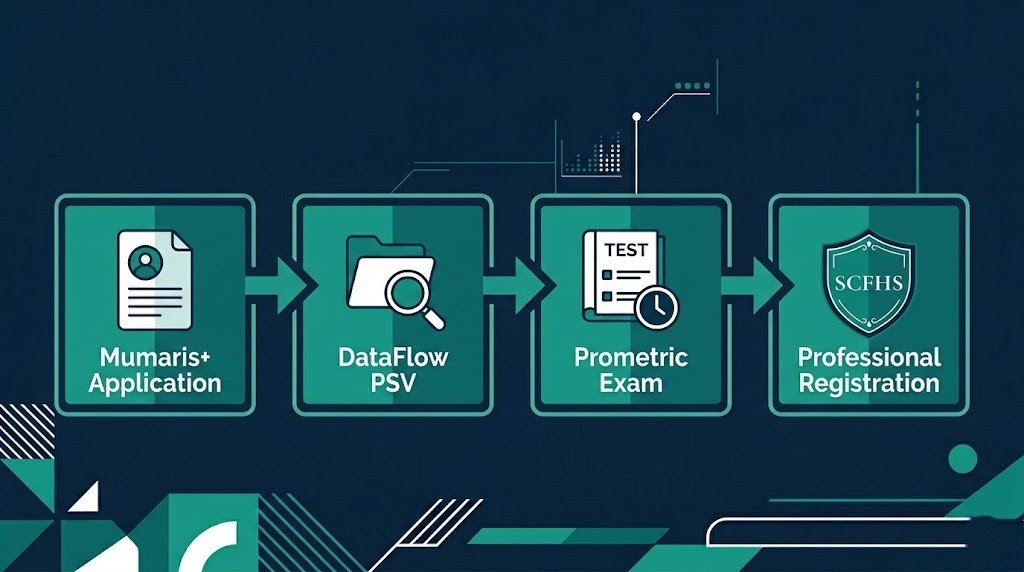
SCFHS licensing involves four stages: Mumaris+ application, DataFlow primary source verification, a Prometric exam, and final professional registration to receive your licence.
Here’s how each stage works in practice:
Stage 1: Mumaris+ Application and Classification Everything starts in the Mumaris+ portal, the official SCFHS digital platform. You create an account, submit your documents, and apply for professional classification. SCFHS reviews your credentials and assigns you to your tier (GP, Specialist, Consultant). Classification approval takes 7 to 35 working days, depending on whether your application requires a practical evaluation.
Stage 2: DataFlow Primary Source Verification, All documents issued outside Saudi Arabia go through DataFlow, the primary source verification (PSV) provider approved by SCFHS. DataFlow contacts your medical school, home-country licensing council, and previous employers directly to verify every document. This stage takes 4 to 12 weeks. Common delays come from slow council responses, name inconsistencies across documents, and employer contact difficulties. Running DataFlow in parallel with your classification prep (not after it) is the single biggest time-saver in the process.
Stage 3: Prometric Exam Once your DataFlow report comes back positive and your eligibility is confirmed in Mumaris+, you book your exam through Prometric. The Saudi Licensing Exam (SLE) is a computer-based MCQ test available at Prometric centres worldwide. Results are posted to your Mumaris+ account within 7 to 10 working days for most titles. The pass mark sits between 60% and 70%, depending on specialty and classification level.
Stage 4: Professional Registration Once you’ve passed the exam, you return to Mumaris+ to complete professional registration. This requires proof of your exam result, a valid Iqama (your Saudi residency permit), and payment of the SAR 1,140 registration fee. At this point, SCFHS conducts a final review of your full file. If everything is in order, your professional registration card is issued, and you can legally start work.
For a full breakdown of each document required at every stage, see our complete SCFHS licence guide.
How Long Does SCFHS Licensing Take for Doctors?
SCFHS licensing typically takes 5 to 8 months for doctors. DataFlow alone runs 4 to 12 weeks. Running DataFlow and exam preparation in parallel saves 6 to 10 weeks.
That 5 to 8 month window assumes no major delays. In reality, the most common reasons applications run longer are: document name inconsistencies that DataFlow flags, slow responses from home-country licensing councils, missing logbooks for surgical specialties, and incorrect classification tier applications that require resubmission.
An Egyptian doctor with 6 years of internal medicine experience came to us after spending 3 months trying to manage his Mumaris+ application alone. His DataFlow had stalled because his hospital’s employer verification letter didn’t specify his specialty by name, only his department. We identified the issue, coordinated directly with the hospital HR to issue a corrected letter, and his DataFlow was cleared within 4 weeks. His total timeline from that point was just under 5 months.
That kind of delay is preventable. Getting the documents right before submission matters: correct formats, consistent names, and correct employer attestation. That’s exactly what the pre-submission audit in our SCFHS Prometric exam preparation service is designed to catch before you submit.
SCFHS vs DHA: One Licence for the Whole Country
This is the comparison that surprises most doctors coming from the UAE licensing world.
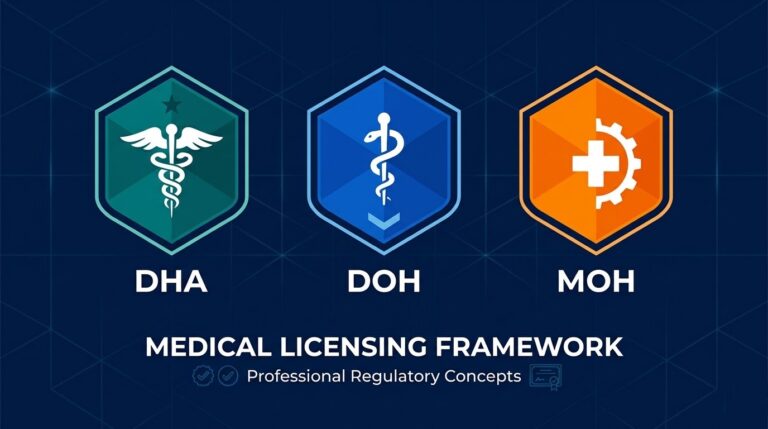
In the UAE, there is no single medical licence. Dubai requires a DHA licence issued through the Sheryan portal. Abu Dhabi requires a separate DOH licence through the Malafi system. The five northern emirates (Sharjah, RAK, Ajman, Fujairah, and UAQ) require an MOH licence. These three authorities don’t cross-recognise each other. A DHA-licensed doctor cannot work in Abu Dhabi without also going through DOH. That’s three separate processes for one country.
SCFHS doesn’t work that way. One SCFHS professional registration covers every hospital and clinic across the entire Kingdom: Riyadh, Jeddah, Dammam, Abha, Tabuk, all of it. You apply once, you register once, and your licence is valid nationally. That centralised model is one of the practical reasons Saudi Arabia appeals to doctors who want simplicity after navigating the UAE’s fragmented system.
The trade-off is timeline. Saudi SCFHS typically runs 5 to 8 months. UAE DHA runs 4 to 6 months, and MOH can be 3 to 5. Saudi Arabia’s process is longer, but it unlocks a single, nationwide licence and access to the largest healthcare market in the GCC.
What to Do Next
If you’re a doctor considering Saudi Arabia, the most useful first step is a free eligibility check. It takes about 10 minutes and tells you which classification tier you’d likely fall into, whether your current qualifications meet SCFHS requirements, and what your realistic timeline looks like from today.
We handle eligibility assessments at no charge, with no obligation to proceed. We’ll also tell you honestly if your profile isn’t ready yet and what you’d need to fix before applying.
If you’re ready to start the full process, our free eligibility assessment page walks through how we work and what to expect from our application management service.
Frequently Asked Questions
Q: Can I start the SCFHS process before I have a job offer in Saudi Arabia?
A: Yes, and it’s usually the smarter move. You can complete your Mumaris+ classification, DataFlow verification, and even sit your Prometric exam before securing employment. Arriving in Saudi Arabia with a positive DataFlow report and confirmed eligibility makes you a significantly stronger candidate to employers.
Q: Does SCFHS accept medical degrees from India, Pakistan, Egypt, and Nigeria?
A: Yes. SCFHS accepts degrees from a wide range of countries, provided the awarding institution is on its recognised list, and the credentials pass DataFlow primary source verification. Indian doctors with MCI/NMC registration, Pakistani doctors with PMDC credentials, Egyptian and Nigerian doctors with recognised postgraduate qualifications are all eligible to apply. Classification tier depends on the degree level and years of verified experience.
Q: Is the SCFHS Prometric exam the same as the DHA exam?
A: No. The Saudi Prometric exam, officially called the Saudi Licensing Exam (SLE), is a separate examination administered by SCFHS. It is not interchangeable with the DHA Prometric MCQ, the DOH Pearson VUE CBT, or any other GCC licensing exam. Each authority runs its own exam. Passing DHA does not exempt you from SCFHS.
Q: What is the cost of SCFHS registration for doctors?
A: The classification fee is SAR 200 for most physician categories. DataFlow verification costs between SAR 400 and SAR 900 depending on how many documents require verification. The Prometric exam fee varies by specialty. Final professional registration costs SAR 1,140. Total investment across the full process typically falls between $680 and $850 USD, not including any translation or attestation costs.
Q: How often does the SCFHS licence need to be renewed?
A: SCFHS professional registration requires renewal. Professional classification is valid for one year for registration purposes. If your classification period expires before you complete registration, you must apply for reclassification before proceeding. Once registered, renewal timelines and requirements depend on your classification level and specialty.