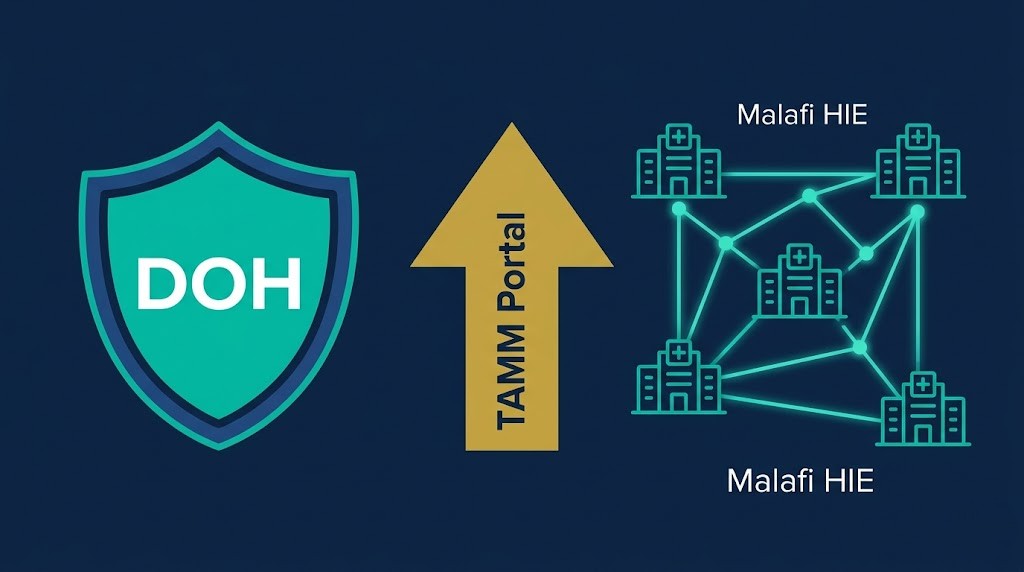
The DOH licence is issued via the TAMM portal and is required to practise in Abu Dhabi and Al Ain. Malafi is the emirate-wide Health Information Exchange. It’s not an exam, not a separate licence, and not something you register in personally. Your employer connects you to Malafi when you join a DOH-licensed facility. This guide covers every step: eligibility, DataFlow, DOH exam, fees, and what Malafi actually means for your daily practice.
You’ve been offered a job in Abu Dhabi. The offer letter says you need a DOH licence. Somewhere in the paperwork, you’ve also seen the word “Malafi.” Now you’re not sure if Malafi is another exam, a separate portal you need to apply through, or something your employer handles for you.
It’s a fair question. Most licensing guides online mention Malafi once and move on, leaving you with the same confusion you started with.
Here’s the short version: Malafi has nothing to do with getting your DOH licence. It’s the system your Abu Dhabi hospital or clinic uses to share patient records across the emirate. You’ll interact with it daily once you start work, but it doesn’t add a single extra step to your DOH licence application.
This guide covers both: how the DOH licensing process works through TAMM, and what Malafi actually means for you as a practising clinician.
What Is the DOH Licence and Which Emirates Does It Cover?
The DOH licence is issued by the Department of Health Abu Dhabi via the TAMM portal. It is valid only in Abu Dhabi and Al Ain, not Dubai or the Northern Emirates.
The Department of Health (DOH) is Abu Dhabi’s health regulator. It issues licences for every clinical profession: doctors, nurses, pharmacists, dentists, and allied health professionals. Without a DOH licence, you cannot practise in any hospital, clinic, or health facility in Abu Dhabi or Al Ain, regardless of whether you hold a DHA licence for Dubai or an MOH licence for the Northern Emirates.
This is a point that catches many professionals off guard. A colleague who completed the DHA process for Dubai cannot simply transfer that licence to Abu Dhabi. The three UAE health authorities (DHA, DOH, and MOH) are completely separate. Each has its own portal, its own exam, its own DataFlow process, and its own licence. There is no cross-recognition between them.
For a full comparison of how these three authorities differ, see our DHA vs DOH vs MOH guide.
What Is the Malafi System and Why Do Healthcare Professionals Need to Understand It?
Malafi is Abu Dhabi’s Health Information Exchange, connecting 2,700+ facilities. It is not a licence or exam. It’s the system your employer uses to share your patients’ records securely.
Malafi (Arabic for “my file”) is the region’s first Health Information Exchange (HIE). The Department of Health Abu Dhabi officially describes Malafi as a key strategic initiative connecting every public and private healthcare facility in Abu Dhabi. Today, 100% of Abu Dhabi hospitals and 99% of all patient episodes are connected to it.
What this means in practice: when a patient visits a private clinic in Khalifa City and then goes to an emergency department in Madinat Zayed, the ER team can see that patient’s existing medications, allergies, and recent lab results in real time. No repeat tests. No missing allergy information. No delayed treatment while a fax machine warms up.
As a clinician, you’ll access Malafi through your facility’s Electronic Medical Record (EMR) system, not through a separate portal or login. Your hospital or clinic configures this access when you join. The DOH mandated that all licensed facilities must participate in Malafi as a condition of their own facility licence, effective from April 2021.
So when you hear “Malafi-connected facility,” it simply means the hospital or clinic you’re joining is compliant with that DOH mandate. Almost every healthcare facility in Abu Dhabi now is.
Do You Personally Need to Register in Malafi for Your DOH Licence?
No. Individual professionals do not register in Malafi. Your DOH-licensed facility onboards you automatically when you join. Malafi access is employer-managed, not self-registered.
This is the most searched question about the DOH-Malafi combination. It’s also the one no other licensing guide currently answers directly.
Here’s how it works. When you accept a job offer from an Abu Dhabi hospital or clinic, your employer sponsors your DOH licence application through TAMM. Once your licence is issued and you start work, the facility’s IT or clinical informatics team sets up your EMR access, connecting you to Malafi. You receive login credentials for the facility’s EMR system (such as Cerner, Epic, or a locally-approved platform). Malafi runs in the background of that system.
You don’t apply to Malafi. You don’t submit documents to Malafi. You don’t pay a fee to Malafi. Your employer handles the facility-side integration. Your role is to follow the EMR protocols during your clinical induction.
One thing worth knowing: your employer may include a brief Malafi or EMR orientation as part of your first-week onboarding. This is not an exam. It’s a practical walkthrough of how to document clinical notes and how cross-facility record access works. Most professionals from Indian, Filipino, Pakistani, and Egyptian healthcare systems find it straightforward once they’ve had a single session.
Who Needs a DOH Licence in Abu Dhabi?
Any doctor, nurse, pharmacist, dentist, or allied health professional working in Abu Dhabi or Al Ain must hold a valid DOH licence before starting clinical practice.
This covers a wide range of professions. Doctors (GPs and specialists), registered nurses, midwives, pharmacists, dentists, physiotherapists, radiographers, laboratory technicians, and TCAM (traditional, complementary, and alternative medicine) practitioners all require a DOH licence. Working without one is a regulatory violation. Your employer cannot legally activate your employment in a clinical role without it.
The DOH licence requirement applies whether you’re joining a large public hospital under the Abu Dhabi Health Services Company (SEHA), a private hospital group, a specialist clinic, or a community health centre in Al Ain.
Fresh graduates should note: the DOH generally requires a minimum of two years of post-qualification clinical experience. If you completed your internship recently and have under two years of experience, the UAE MOH licence (which covers the Northern Emirates) may be a more accessible starting point. Our DOH licence Abu Dhabi page covers the eligibility requirements in full detail by profession.
Are You Ready to Apply for Your DOH Abu Dhabi Licence?
3 quick questions. Get your personalised next step.
No free consultations. Paid assessment — serious applicants only.
Step-by-Step: How to Get Your DOH Licence Through TAMM
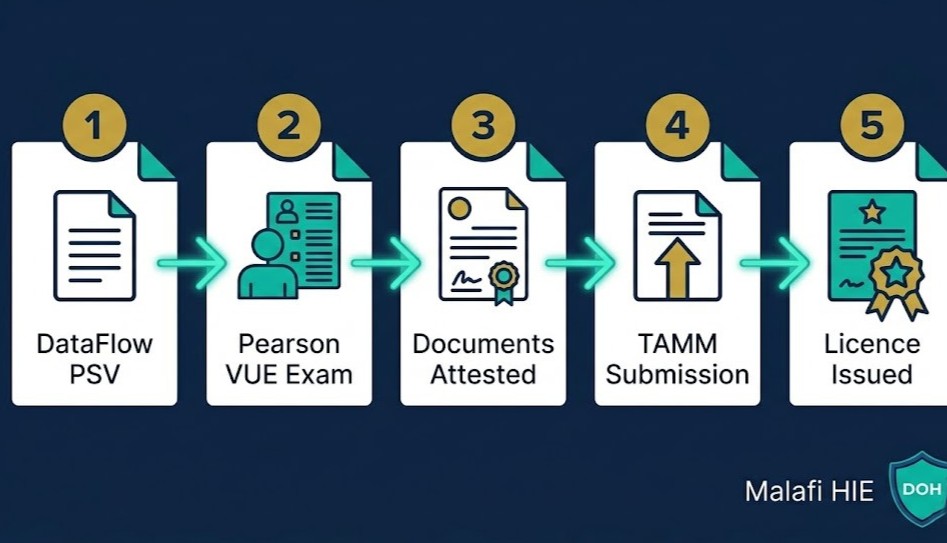
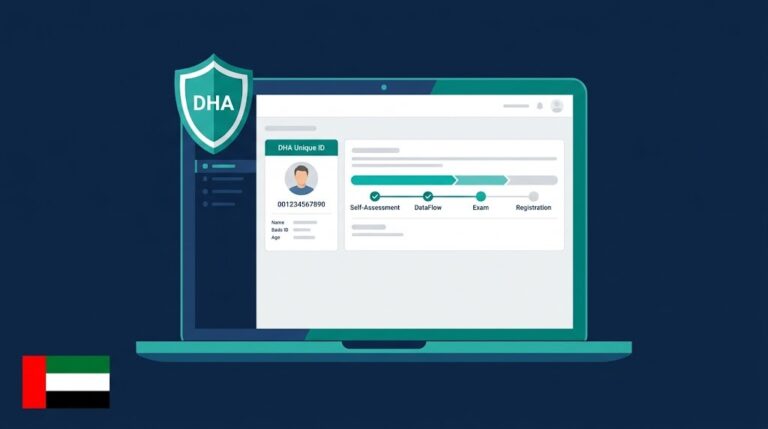
The DOH licensing process runs through TAMM, Abu Dhabi’s integrated government services portal. You’ll also need a UAE PASS digital ID. Here are the stages in sequence:
Step 1: DataFlow Primary Source Verification (PSV)
DataFlow is the mandatory credential verification service for all UAE health authorities, including DOH. It contacts your degree-issuing university, your home-country medical or nursing council, and your previous employers to verify your qualifications and experience directly at the source.
DataFlow typically takes 4–12 weeks. The most common delays are slow responses from home-country councils (NMC in India, PRC in the Philippines, PMDC in Pakistan, NMC in the UK) and employer verification letters that lack specific job duties.
We run DataFlow in parallel with your exam preparation. This alone saves most applicants 6–10 weeks compared to doing them sequentially.
Step 2: DOH Licensing Exam (Pearson VUE)
Most professions require a DOH licensing exam, delivered by Pearson VUE as a computer-based MCQ test at approved centres globally. The exam is specific to DOH. It is not the same as the DHA Prometric exam or the SCFHS Saudi Prometric exam, and passing one does not exempt you from the others.
Some professions may qualify for an exam waiver based on nationality and qualification source. Check the DOH Professional Qualifications Requirements (PQR) document for your specialty.
Step 3: Document Preparation
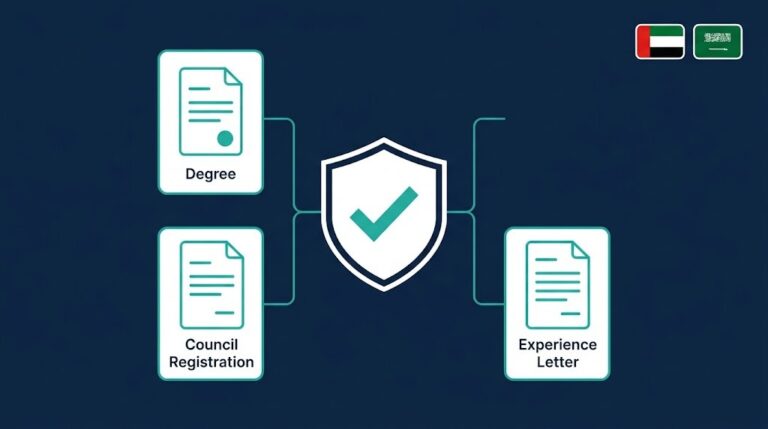
Core documents required for most professions: degree certificate, academic transcripts, home-country council registration, good standing certificate, experience letters (with job duties and dates), passport copy, and a recent photo.
All documents must be attested. Document requirements vary by profession and nationality. An Indian MBBS graduate has a different attestation path than a Filipino registered nurse or a UK-trained dentist.
Step 4: TAMM Application Submission
Once DataFlow returns a positive Primary Source Verification report, you submit your full application via TAMM using your UAE PASS credentials. Your employer’s PRO (Public Relations Officer) typically coordinates this step, as the licence is employer-sponsored.
Step 5: Licence Issuance and Employer Activation
The DOH reviews your application. Processing time after a complete submission is typically 2–4 weeks. Once issued, your employer activates the licence through their own DOH facility account. This is the final step before you can begin clinical practice.
Our licence application service covers Steps 1 through 5 end-to-end. We run a pre-submission audit before your TAMM submission to catch any document errors before the portal rejects them.
DOH Licensing Fees and Timelines: What to Budget
Fee structures vary by profession. Published figures from independent licensing guides indicate typical DOH application fee ranges of AED 2,237–5,327, depending on profession and licence type. Exam fees, DataFlow fees, and attestation costs are separate. Here is a realistic total budget breakdown:
| Cost Item | Approximate Range |
|---|---|
| DataFlow PSV | USD 170–340 (varies by profession and document volume) |
| DOH Exam Fee | AED 700–1,200 (Pearson VUE, varies by specialty) |
| DOH Application Fee | AED 2,237–5,327 (by profession) |
| Document Attestation | AED 200–800 (depends on number of documents and origin country) |
| Total Estimate | AED 3,500–8,000+ |
For CME-based renewal, the DOH requires profession-specific continuing medical education hours: Physicians need 40 CME hours per licence cycle, Nurses need 20, Pharmacists need 20, and Allied Health Professionals need 10.
Total timeline: From starting DataFlow to receiving your issued DOH licence typically takes 4–6 months. Running DataFlow and exam preparation in parallel reduces this to 3–4 months for well-prepared applicants with clean documentation.
Malafi vs Sheryan vs DHA Systems: What’s Different?
DOH Abu Dhabi uses TAMM for licensing and Malafi for health-record sharing. DHA Dubai uses Sheryan for licensing and its own e-health systems. Neither authority recognises the other’s licence.
This comparison matters if you’re deciding between Abu Dhabi and Dubai, or if you’re planning to move between the two later in your career.
The Sheryan portal is DHA’s equivalent of TAMM. If you hold a DHA licence and want to move to Abu Dhabi, you cannot transfer it. You apply for a DOH licence from scratch, including a new DataFlow PSV and (usually) a new exam. Similarly, a DOH licence does not grant you the right to see patients in a Dubai clinic.
The health-record side is equally separate. Malafi connects Abu Dhabi facilities. DHA operates its own patient data infrastructure. The two systems do not share records directly. So if a patient treats in Dubai and then moves to Abu Dhabi, their DHA-system records are not automatically visible in Malafi. The patient would need to consent to sharing or present their documents manually.
For professionals thinking about GCC career moves beyond the UAE, SCFHS in Saudi Arabia uses the Mumaris+ portal for licensing and has its own separate national health data strategy, and Qatar’s QCHP operates independently of both Malafi and Sheryan.
Your DOH Licensing Path by Nationality and Profession
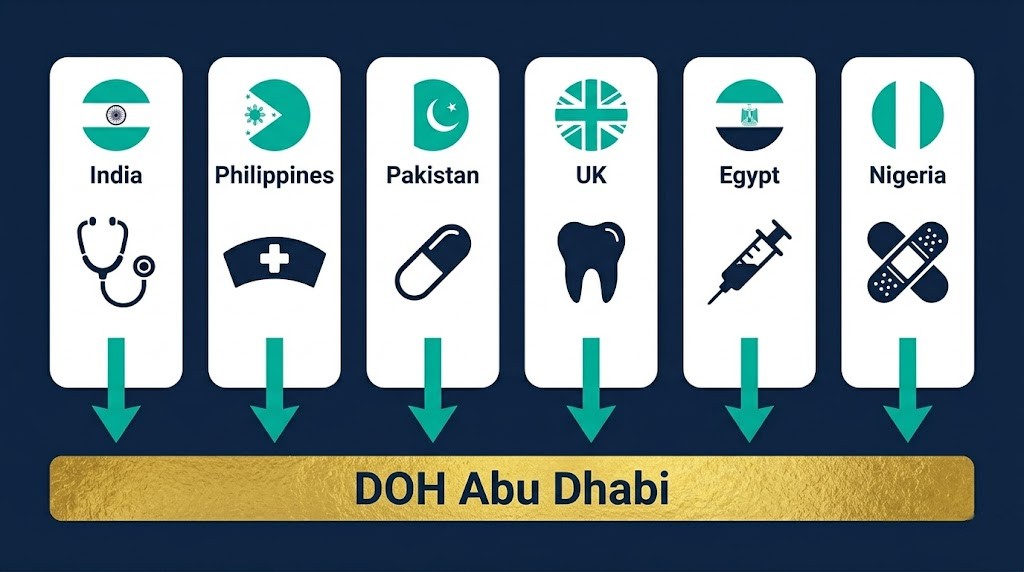
This is the section no other DOH guide currently provides. Your home-country council, the DataFlow institutions contacted, and whether you qualify for any exam exemption, all depend on where you trained.
| Nationality | Profession | Home Council | DataFlow Key Contacts | DOH Exam |
|---|---|---|---|---|
| Indian | Doctor | NMC India (formerly MCI) | University + NMC + Previous employers | Required for most |
| Indian | Nurse | INC (Indian Nursing Council) | University + INC + Employers | Required |
| Filipino | Nurse | PRC (Professional Regulation Commission) | University + PRC + Employers | Required |
| Pakistani | Doctor | PMDC / PMC | University + PMC + Employers | Required |
| UK-trained | Doctor | GMC (General Medical Council) | University + GMC + Employers | May qualify for exemption (check PQR) |
| Egyptian | Doctor | Egyptian Medical Syndicate | University + Syndicate + Employers | Required |
| Nigerian | Nurse | NMCN (Nursing and Midwifery Council of Nigeria) | University + NMCN + Employers | Required |
A Pakistani doctor registered with PMDC / PMC takes a different DataFlow path than a Filipino nurse registered with PRC. Both take longer than a UK-trained doctor whose GMC registration is verifiable online. UK-trained doctors may also qualify for a DOH exam exemption under the Professional Qualifications Requirements.
An Indian nurse from Kerala with 4 years of ICU experience at a private hospital had her DataFlow delayed by 7 weeks because her employer’s experience letter listed her department but not her specific clinical duties.
We followed up directly with the hospital HR, requested an amended letter specifying her patient ratio and procedures performed, and her DataFlow report came back positive within two weeks of resubmission. Her DOH licence was issued in just under 4 months total.
If you’re unsure which path applies to your qualification and nationality, a free eligibility assessment is the fastest way to get a clear answer.
3 Malafi Myths That Are Confusing Healthcare Professionals
Myth 1: “Malafi is another exam or course I need to pass before starting work in Abu Dhabi.” This is the most common misconception. It’s completely wrong. Malafi is an electronic health record exchange system.
There is no Malafi exam, no Malafi certificate, and no Malafi application. Your DOH licensing exam is through Pearson VUE and is profession-specific. The two have nothing to do with each other.
Myth 2: “Only government hospitals use Malafi. I can avoid it by joining a private clinic.” The DOH mandated Malafi participation for all licensed healthcare facilities, public and private, as a condition of facility licensing. A private clinic in Al Reem Island is under the same obligation as Sheikh Khalifa Medical City. There is no opt-out.
Myth 3: “Malafi increases my personal legal risk as a clinician. I’ll be responsible if patient data is breached.” DOH sets strict data-protection protocols under the Abu Dhabi Healthcare Information and Cyber Security (ADHICS) framework. Facilities are responsible for system-level security and integration.
As a clinician, your responsibility is to follow EMR documentation protocols, not to build or maintain the system. Routine, appropriate use of Malafi through your facility’s EMR carries no greater legal exposure than documenting in a paper chart.
What to Do Next: Free Eligibility Assessment
Getting your DOH licence is a process with a clear sequence. DataFlow, the Pearson VUE exam, TAMM submission, and employer activation each take time, but they can be planned in parallel to cut your total timeline significantly.
What often causes delays isn’t the process itself. It’s document gaps, name inconsistencies between certificates, and experience letters that don’t meet DOH’s specific requirements. A pre-submission audit catches all of this before your application reaches the portal.
If you’re a doctor, nurse, pharmacist, dentist, or allied health professional planning to work in Abu Dhabi, start with a free eligibility check. We’ll tell you exactly which documents you need, whether you qualify for any exam exemption, and how long your specific path is likely to take.
Frequently Asked Questions
Q: Can I use my DHA licence to work in Abu Dhabi without applying for a DOH licence?
A: No. A DHA licence is valid only in Dubai. Abu Dhabi requires a separate DOH licence issued through TAMM. The two authorities do not cross-recognise licences, and you cannot practise clinically in Abu Dhabi on a DHA licence, even temporarily.
Q: How long does the DOH licensing process take from start to finish?
A: The full process (DataFlow PSV, DOH exam, TAMM application, and licence issuance) typically takes 4–6 months. Running DataFlow and exam preparation simultaneously reduces this to 3–4 months for applicants with complete, well-prepared documentation.
Q: Does Malafi add any extra steps or costs to my DOH licence application?
A: No. Malafi has no impact on your DOH licence application process or its costs. It is a facility-level system your employer configures when you join. Your licensing fees, DataFlow process, and Pearson VUE exam are entirely separate from Malafi.
Q: Is the DOH exam the same as the DHA Prometric exam?
A: No. The DOH exam is delivered by Pearson VUE and is specific to the Department of Health Abu Dhabi. The DHA exam is delivered by Prometric and is specific to the Dubai Health Authority. Passing one does not exempt you from the other. Each authority sets its own exam content and pass mark by specialty.
Q: What happens to my Malafi access if I leave my Abu Dhabi employer?
A: Your EMR and Malafi access is tied to your employer’s facility system. When you leave, your employer deactivates your credentials as part of the offboarding process. If you join a new Abu Dhabi facility, your new employer sets up access again. Your DOH licence remains active independently of your Malafi access.